At a Glance
- While climate funding is increasing and the climate crisis is increasingly recognized as a challenge to health systems, only 0.5% of total climate funding goes toward protecting health systems from effects of climate change. Among existing funding, a much greater share currently goes to mitigation than adaptation.
- Camber built a first-of-its-kind methodology for Gavi and AIIB to quantify how much existing health and immunization spending already contributes to climate adaptation.
- Applied across $42.2 billion in climate-related health investments, the methodology is reshaping how funders value and direct climate-smart health spending worldwide.
Download Report
$42.2B
investments analyzed
The Challenge
In recent years, extreme climate events have triggered multiple health crises globally. Fortunately, the world has mobilized around confronting this challenge. Fortunately, the world has mobilized around confronting this challenge. However, only 0.5% of total climate funding goes toward protecting health systems from effects of climate change.
Moreover, most health-focused climate financing targets mitigation – reducing the causes of climate change – while far less goes toward climate adaptation – adjusting the systems and strategies that protect communities against the climate impacts already underway. Together, these two gaps highlight one critical shortfall — the systemic underinvestment in health-specific climate adaptation. This presents an opportunity to organize as research shows that increasing climate adaptation investments by 1% could significantly reduce mortality, saving millions of lives.
This underinvestment isn’t inevitable. It reflects a structural bias toward projects that are easy to measure, and adaptation is inherently harder to quantify than mitigation. But health investments represent a significant, underused opportunity to drive climate adaptation, one that’s ready to be put to greater use. Recognizing this potential, in the fall of 2024, Gavi, the Vaccine Alliance, and the Asian Infrastructure Investment Bank (AIIB) engaged Camber to devise a solution, starting with an evaluation of the climate adaptation impact of their health portfolios
Our Approach
Over 6 months, Camber set out with one goal: build a quantitative methodology that would give funders, policymakers, and advocate a credible way to how much health investments specifically support climate adaptation. Using this tool, stakeholders can assess how much of any given health investment contributes to climate adaptation, whether intentionally or not.
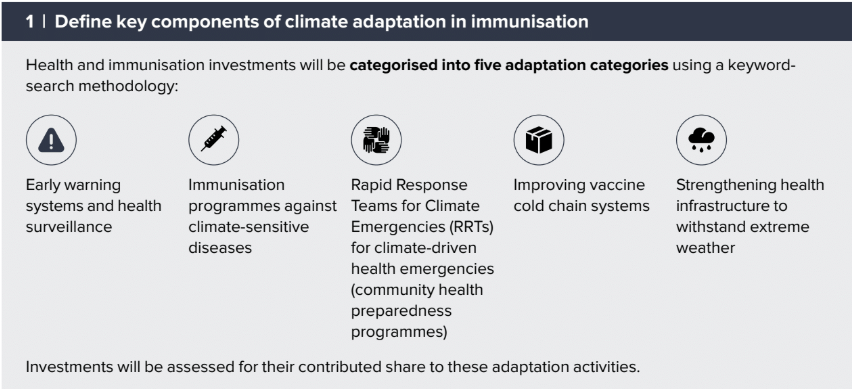
Building this methodology required reviewing and analyzing program data across multiple development finance institutions. We also collaborated extensively with technical experts from the World Bank, ADB, WHO, and academic institutions to stress-test and refine our approach. Together, this work identified five key investment areas, which we call “Adaptation Categories.”
Finally, applied the methodology against six countries highly vulnerable to climate impacts: Bangladesh, Ethiopia, Malawi, Nigeria, Pakistan, and the Philippines. Our analysis found that across countries, investments in health programs with climate adaptation objectives have been increasing since 2019.
Camber set out with a key goal: build a methodology that would give funders, policymakers, and advocates a credible way to estimate the adaptation share of health investments.
Impact & Outcomes
With the methodology validated, Camber applied it at scale, analyzing 17,000 climate-related health and immunization investments totaling $42.2 billion from Gavi, the World Bank, ADB, and AIIB over the past five years. Of that $42.2 billion in climate-health investment, only 8.8%, about $3.7 billion, went toward climate adaptation specifically, exposing a significant gap even within funding earmarked for climate goals.
In November 2025, at COP30, the findings were released as a report, titled Protecting Our Future. The report highlights the often-overlooked role that health systems play in helping communities adapt to climate change, particularly around immunization.
Now, this research is reshaping how the world values health interventions in a climate-stressed era. By surfacing the hidden adaptation impact of existing investments, it lays the foundation for more intentional, climate-smart health spending going forward. Stakeholders are now equipped with shared language and shared tools to advance long-term system change in the communities most vulnerable to climate change.
Partner With Us
We work with changemakers across the social sector—from local non-profits to global multilaterals—to drive measurable impact.