Redefining Cancer Care: City of Hope’s Path to a National Standard
At a Glance
More than 5 million people in the U.S. are living with cancer, yet most do not have consistent access to care that addresses the emotional, practical, and social challenges of a diagnosis alongside treatment.
The work set out an ambitious vision for supportive cancer care as a standard component of cancer care, laying the foundation for a national movement driven by the Together for Supportive Cancer Care coalition of more than 40 organizations.
Camber partnered with City of Hope and the Biller Family Foundation to develop a shared strategy, implementation roadmap, and measurement approach for expanding supportive cancer care beyond a single institution.
The Challenge
In the U.S., over 18.5 million people are living with cancer today, a number expected to climb to 22 million by 2035. A cancer diagnosis reaches far beyond a patient’s physical health, it disrupts family dynamics, careers, and stability for both the patient and their caregivers.
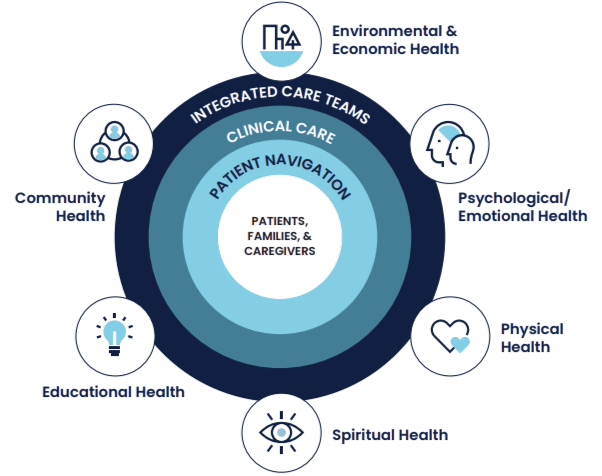
Supportive cancer care is a comprehensive, evidence-based approach to care for people affected by cancer. Supportive Cancer Care (SCC) ensures that the unique needs of people living with cancer and their caregivers are met at every step of their cancer journey, integrating clinical care with physical, emotional, spiritual, economic and community support. Yet access to timely supportive cancer care, even within leading institutions, remains the exception rather than the norm.
Even where SCC has been proven to work, it hasn’t been able to scale. City of Hope, a prominent NCI-designated institution, built an integrated supportive care program with funding from the Biller Family Foundation. However, the model was resource intensive and had not extended beyond City of Hope’s main campus, leaving patients at rural clinics with little to no access to the same support. The Biller Family Foundation and City of Hope saw a bigger opportunity: expanding their reach while establishing supportive care as a national standard. City of Hope engaged Camber to help chart that path.
Supportive Cancer Care (SCC) ensures that the unique needs of people living with cancer and their caregivers are met at every step of their cancer journey, integrating clinical care with physical, emotional, spiritual, economic and community support.
Our Approach
The engagement unfolded in three phases over two years.
Phase 1: Building the Blueprint
In November 2021, Camber worked directly with executive leadership across Biller Family Foundation and City of Hope to build a single, clear vision and strategic plan for democratizing access to supportive care. Within this support, we provided a shared definition for supportive care, integrated siloed initiatives, and built governance structures to drive the work forward.
Phase 2: Turning Strategy into Action
Camber then translated the strategy into an 18-month roadmap for action. This included piloting a scalable model in a select US county at one of City of Hope’s tertiary clinic locations, leveraging digital health channels, and externally communicating the value of the supportive care model. We also built a method to track and measure success over a 3-to-5-year horizon, including a dashboard to monitor and communicate progress and results.
Phase 3: Testing a Path to National Reach
Subsequently, Camber, collaborating with City of Hope, explored Supportive Care Everywhere (SCE), a proposed digital platform to serve as a new distribution channel for the supportive care model, extending its reach well beyond City of Hope’s physical campus. Camber tested the concept through extensive research, gathering input from clinicians, patients, and leading experts, and reviewing dozens of existing digital solutions already on the market.
Spheres of Supportive Cancer Care
Impact & Outcomes
City of Hope moved from a fragmented set of initiatives to a clear, shared strategy for scaling the reach and impact of their SCE initiative, backed by an execution roadmap and a live success measures dashboard. The engagement was grounded in an understanding of the field’s nascency, helping City of Hope define supportive care in a way that could be shared and adopted well beyond its own walls.
Beyond the impact at City of Hope, the strategy continues to serve as a blueprint for expanding access to SCC across the cancer care field. The four-pillar strategy Camber helped develop, was adopted by the Biller Family Foundation to advance supportive care nationally, leading to the formation of the Together for Supportive Cancer Care coalition, bringing more than 40 organizations together across the cancer care ecosystem, is built upon the foundation Camber helped lay. The coalition is a national forum to share best practices and advance supportive cancer care as the standard of care nationally.
Supportive care is more than a model for cancer treatment. It provides a framework and model to be modified and leveraged to support chronic care management more broadly. As the US healthcare system contends with shifting demographics and mounting financial constraints, supportive care offers a transformative path forward, one that redefines patient care around a truly holistic standard, weighing physical, emotional, spiritual, and practical wellbeing equally. The result is a better experience, lower cost of care, and a better standard of living for patients and the caregivers who support them.
Partner With Us
We work with changemakers across the social sector—from local non-profits to global multilaterals—to drive measurable impact.
America’s rural health business model was built to mimic our urban care delivery infrastructure and incentives. It is a model that has been impractical and…
Amid a national dialog on systemic racism, police violence, and COVID-19 contact tracing, the creation of public health case management forces could be a compelling…